David Garfinkle focuses on what good he can make happen today
When David Garfinkle travelled to Hawaii on a corporate retreat in 2014, he was given a choice: a massage or a surfing class. Being adventurous and athletic, he chose the latter.
It was a decision that would change his life.
Garfinkle had never surfed before. As he stood on the board in shallow water, he fell. His last memory was of being lifted back onto the board by his colleagues. Ten days later, he woke up in a hospital bed at Hôpital du Sacré-Cœur-de-Montréal, with his brother standing beside him.
“You’ve really done it now,” his brother told him.
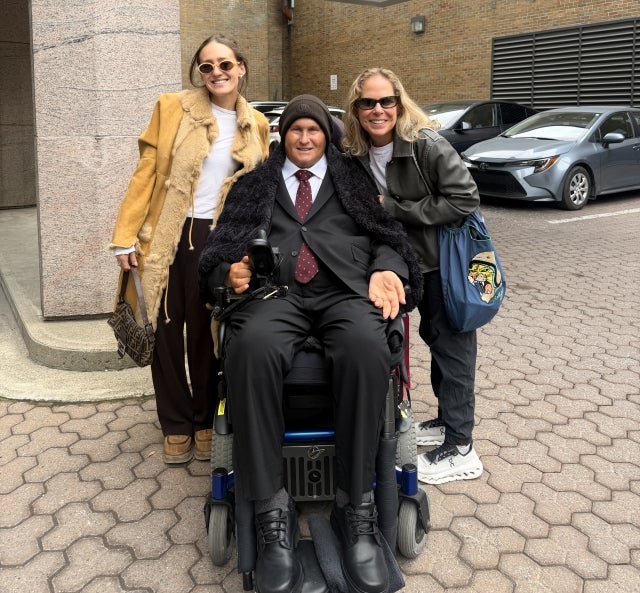
Garfinkle had sustained a C4 spinal cord injury, leaving him quadriplegic.
The news came with a bittersweet reality: he would live, but he would not be able to return to the life he had known before.
“Why me?” he thought to himself.
At 54, Garfinkle had been highly active. He played tennis and hockey, rode bicycles and went to the gym every morning before waking his children for school. Suddenly, even the most basic functions – eating, coughing and breathing – had to be relearned. He spent 11 months in hospital and rehabilitation.
There were moments when the physical and emotional weight of his new reality felt overwhelming. He recalls craving a medication used to treat nerve pain, because it allowed him to sleep and escape what he was experiencing. At times, he wondered, “This is not worth it. Why am I going through all this?”
What helped shift his perspective was meeting Dan Thompson, who later became his mentor. Thompson had also sustained a life-changing injury while playing football in Ontario. Thompson encouraged him to gradually wean himself off the medications that were keeping him heavily sedated and focus on building a life again.
“I don’t want to be a hero, but I also don’t want to be a zero,” Garfinkle remembers thinking. “I want to live. I want a good quality of life.”
Twelve years later, Garfinkle has built a life that looks different from the one he imagined.
He is renovating a home in Vermont that he hopes will become a multigenerational space for his family. He stays connected with his three children, spends time with friends, travels when he can and remains involved in charity work. In 2025, he and his children helped raise more than $400,000 for the Neuro-Efficiency Foundation.
But moving forward has not meant leaving grief behind.
Garfinkle still misses the spontaneity of his old life: playing sports, travelling easily, going to the gym and maintaining the kind of romantic relationship he once had. Even getting ready in the morning can be a re-minder of how much his pace has changed. What once took minutes can now take more than an hour.
He is learning to give himself grace.
“I’d rather be on the offence than on the defence, starting early in the morning,” he said. When frustration sets in, he reminds himself that he has a whole day to get things done.
For Garfinkle, healing has not meant forgetting what he lost. It has meant figuring out what deserves his energy.
“I don’t want to think every day I wake up, ‘what bad is going to happen today?’” he said. “I’m the opposite. What good can I make happen today?”
For now, that can mean something as sim-ple as talking to his children, reaching out to a friend or going for a walk.
“Life is good. It could be better, but it’s good.”
If you would like to bring David Garfinkle to your school, email us at info@inspirationsnews.com
This story has been adopted by Robert Beck, a friend of David Garfinkle. We are grateful to Robert for his generous support and for helping bring stories like this to our readers. Our Adopt-a-Story initiative offers donors the opportunity to support the stories, topics and voices that matter to them.