Loving Stephanie
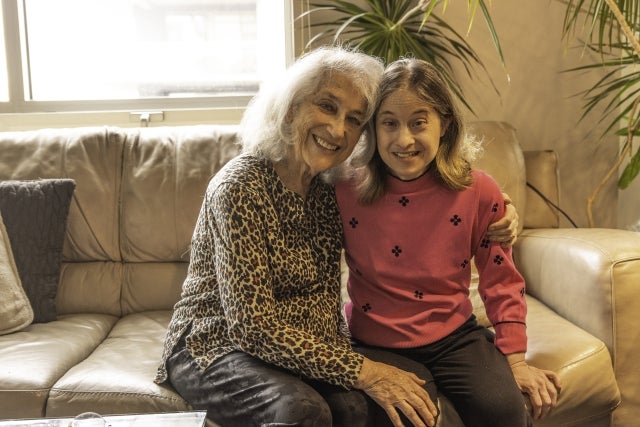
Aliza Boghen had seven-year-old twin sons, Alexander and Daniel, when Stephanie was born. The doctor told her immediately that her daughter had Down syndrome. “This was not the child I expected,” said Boghen. “There was the initial shock and then fear for a future full of unknowns.”
Boghen recalls returning home with the baby and feeling overwhelmed by concern. She had been crying when she answered a call from her mother. “We are delighted to have a little girl in the family,” said her mom. And Boghen smiled, shared in the joy and then went back to crying.
But her sadness was short-lived.
“Our Stephie was so sweet and adorable,” she said, “I remember washing dishes and feeling blue when she crawled over and sat by my legs. I looked down, and she was looking up at me with the biggest smile; it was like she knew I needed something.”
They all fell deeply in love with her.
“Even before she could talk, Stephie’s good nature and sweet personality brought us such joy,” said Boghen. “I would often say, ‘Everyone should have a Stephie at home.’”
The family grew to welcome another child into the family, Jennifer, and soon after Stephanie began going to school. A few days after she started pre-kindergarten at age four, Boghen received a call from the school saying that her daughter could not continue with them: she required extra attention they were not able to provide.
“I wasn’t sure what to do until I read about the Miriam Home School and thought it could be something for Stephie,” she said. “I registered her there when she was five.” One of the aides in the classroom took
a special interest in Stephanie and would take her out of class for an hour or two each day. Within two weeks, she was reading and showed an exceptional aptitude for learning. The school put on a play about Goldilocks, and Stephanie landed the title role.
“The first time I saw her on stage I knew she was a natural actress,” Boghen said. As a young adult, Stephanie joined I Can Dream Theatre.
Her love for the arts continued into her adulthood. When Stephanie was 33, she entered the three-year Centre for the Arts in Human Development program at Concordia, where she learned about behaviour through acting and music. She was also working at Maimonides Geriatric Centre doing office tasks.
Four years ago, 45-year-old Stephanie was diagnosed with Alzheimer’s disease.
Although Boghen had worked as an animator for seniors with Alzheimer’s, she did not know about its connection to Down syndrome. “I am well aware of the prognosis,” Boghen said. “I have always accepted Stephie as she is and will continue with this latest hurdle.
“I have wonderful children, and we are all very close,” she said. “My kids, their spouses and children are my support network.”
Boghen has noticed the rapid progression of her daughter’s Alzheimer’s, most recently, her loss of mobility.
“I accept that this is my Stephie now; I am realistic and know that things will continue to change,” said Boghen. “We will go with the flow; when she needs more care than I can provide, we will find the right placement for her.”
Just before the diagnosis, Stephanie had been cast in Infinithéâtre’s production of Extra/Beautiful/U, which played at Centaur Theatre. She was to play the main character’s younger sister, who had Down syndrome.
“It was incredible,” Boghen said. “They put the script in front of her, and she embodied the role.” However, with the symptoms of Alzheimer’s, she could not continue. The playwright, Michaela Di Cesare, dedicated her play to Stephanie.